German Design Awards Reduce Event Carbon Footprint by 23%
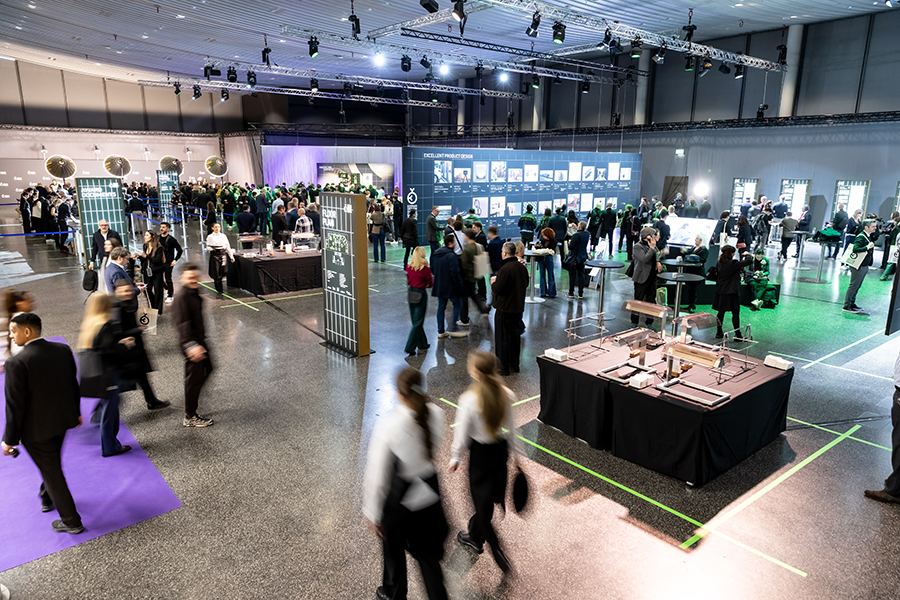
Since introducing the Circular Design category in 2024 and strengthening sustainability criteria across all competition categories, the German Design Awards have reinforced the role of design as a driver of sustainable transformation. The aim is to measure emissions transparently, identify opportunities for further reductions and make future decisions based on reliable data.
The assessment covers both the international jury session and the awards ceremony. It was carried out in accordance with internationally recognised standards, including the Greenhouse Gas Protocol (GHG Protocol) and the AUMA Guideline for Greenhouse Gas Accounting.
Key Figures
- Total event carbon footprint: 219.00 t CO₂e
- Reduction compared with 2023: 23%
- Largest source of emissions: Participant travel, accounting for 174.123 t CO₂e (79.5%)
- Additional emission sources: Winner services (18.730 t), energy (17.005 t), logistics (4.500 t), accommodation (1.743 t) and catering (1.317 t)
- Emissions below one tonne: Materials, digital communication, waste and water
- Share of guests travelling by rail increased from 28% (2025) to 35% (2026)
Mobility Remains the Largest Source of Emissions
Participant travel remains the single largest source of emissions, accounting for nearly four fifths of the event's total carbon footprint. By comparison, materials, digital communication and waste have only a limited impact on overall emissions.
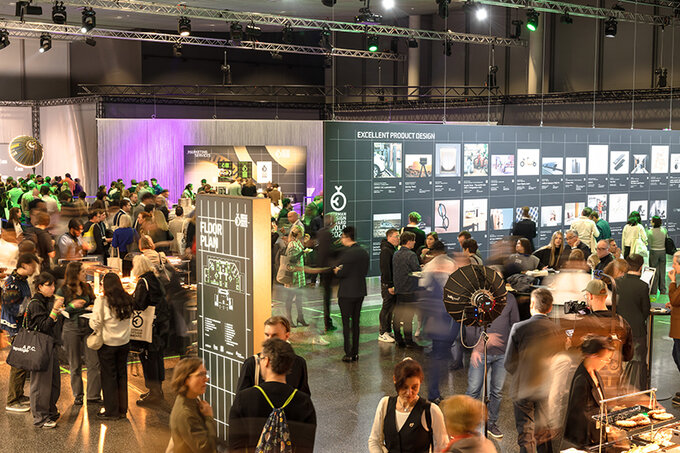
Several measures have already been implemented to reduce the event carbon footprint. The former physical exhibition was replaced with a digital format, while an additional exhibition and trade fair stand were discontinued. More competition entries were submitted digitally during the jury process, and the event relied primarily on borrowed and reusable materials. At the same time, data collection and reporting have become more robust and standardised.
In the coming years, the German Design Awards will focus on expanding low-carbon travel options, introducing stronger sustainability standards for suppliers, increasing the reuse of materials and continuously improving the quality of the underlying data. The objective is to measure progress transparently and systematically reduce the event carbon footprint over time.
Embedding Sustainability Into the Awards
Sustainability is one of the core evaluation criteria of the German Design Awards. The introduction of the Circular Design category in 2024 marked an important milestone, while principles such as resource efficiency, longevity, circular material systems and social responsibility are now assessed across all competition categories.
Measuring the event's own carbon footprint is a natural extension of this commitment. Sustainability is not only recognised in the awarded projects but is also embedded in the way the awards are organised. The carbon footprint assessment provides a robust data foundation for monitoring progress and continuously developing the German Design Awards.
Submit Your Work to the German Design Awards 2027
The call for entries for the German Design Awards 2027 is open until 11 September 2026. The competition is looking for products, projects and concepts that combine outstanding design with meaningful responses to the ecological, economic and social challenges of our time.
An international jury of around 50 independent design experts will select the winners in early October. Across all competition categories, sustainability, innovation and long-term relevance remain central to the jury's evaluation.